While reading one night, I came across the following passage in The Bright Years by Sarah Damoff. In it, the lead male character is proposing to Lillian, his girlfriend. What could have been written as: he got down on a knee and said, “Lillian, will you marry me?” — which would have “done the job” of letting the reader know what happened and getting us to what comes next — the author takes six paragraphs (they’re short, but still, six paragraphs!) to expand the moment.
This is a great example of Slowing Down a scene.
Please read this in its entirety:
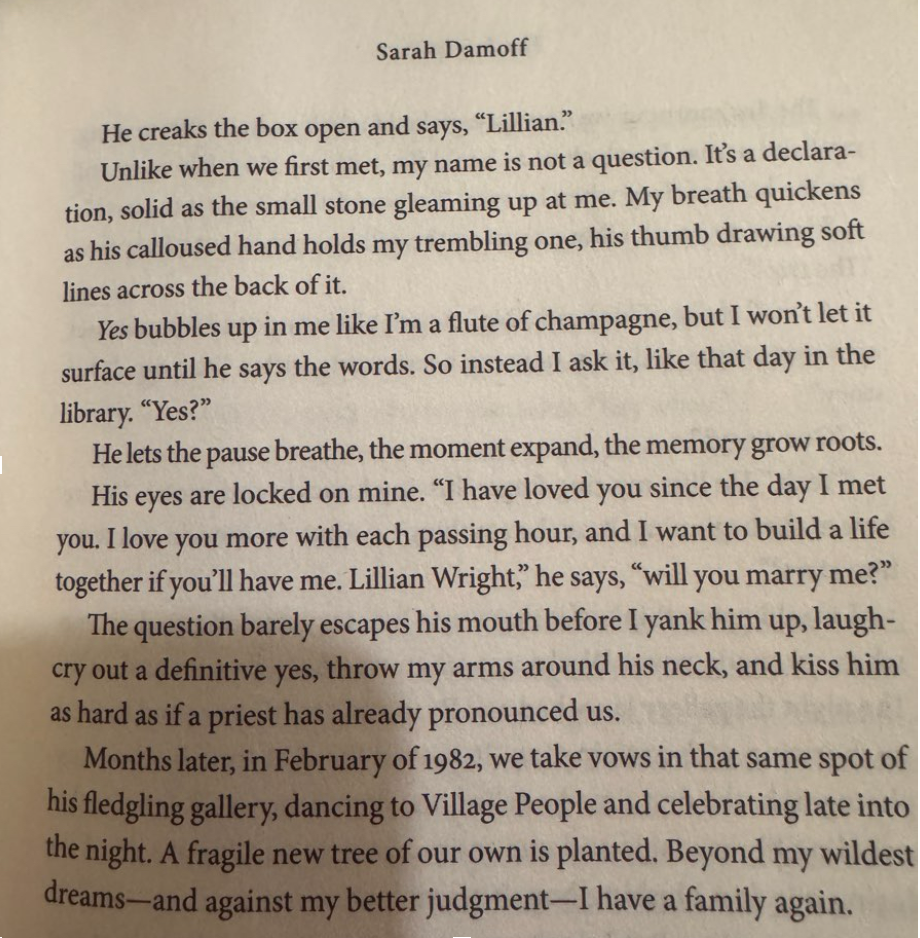
(Forgive my cell phone shadow in the picture.)
Could the author have written a short version of this proposal? Sure.
So why didn’t she?
Put a pin in that question. And let me tell you a little story.
///
About a year ago, I started working with a writer through what we first called a ‘discovery phase’— she wrote what she wanted (and dare I say needed?) to write, without pressure on what her words would ultimately become. But pretty quickly, the work declared itself to be a manuscript.
As the writing continued to expand and undergo edits, an issue arose: some important emotional moments felt skimmed over.
“Slow this down,” I’d say. “Let the reader feel the impact of this with you.” (If you’ve ever taken a writing workshop with me, it’s likely you’ve received this feedback as well.)
Understandably, the next question then became: Well, which moments do you slow down? Surely we can’t slow down every moment of our essays, let alone a full manuscript.
I’m not a trained writer. I have no English, journalism, or—I don’t know—an Obscure Poetry of the Middle Ages degree. But I am a pretty decent reader. And most everything I’ve learned about writing, came from cumulative the pages of the books I’ve read.
This lack of proper training means that I’ve had to come up with my own ways to explain why a passage works (or doesn’t), and not simply saying, “I don’t know, it just feels right.”
When I read this Bright Years passage, I immediately sent it (and a corresponding voice memo) to my writer-friend as an example of how to slow down a moment.
///
After I sent the passage, my writer-friend responded, and because work and friendship often mix, she had also asked me about my birthday. I’d turned a tender age this year, the same age my mom was when she died.
It can be hard to put into words something so big and heavy as a milestone birthday, so as writers are prone to do, I started to tell her a different story, one I hoped would explain what was on my mind and in my heart.
“My grandfather, my dad’s dad, died at 50,” I’d said.
“My dad was 23, and had been married to my mom for only three months. My grandmother still had 5 kids living at home, ages 22 down to 13—it was a tragedy from every angle. And my dad, for all intents and purposes, became the Man of the family from that point forward.”
I continued, “On my dad’s 51st birthday — not his 50th — we all sat around the kitchen table when his birthday cake was placed in front of him. My step-mom, aunts, an uncle, some cousins, and my brother and sister and I all sang while he smiled and bowed his head. In my memory it was a pineapple upside down cake, the kind my mom used to make him, with walnuts in the open hole in the middle of each pineapple slice.
“And when we were done singing, he blew out the candles, then lowered his head again,”—
this is where my voice began to catch
—“and I remember watching him as he took one long, slow, deep breath out.”
I wiped away tears, “I didn’t think I’d get emotional telling you this,” I said.
“But it was like,” I continued through the tears, “it was like …”
Here, I took my own long, slow, deep breath.
“It was like I could see him, now at 51, thinking: I made it.”
I paused. What I didn’t say out loud: 48 so far is okay, but I think the weight of what I’m carrying this year will show up when I make it to 49. That was how I was feeling about my own birthday.
But as any writing teacher worth her salt does, I also understood, in real-time what I’d just done.
In slowing down this story of my own, in sharing the details of the scene—who was there, what was served … I could smell the cake as I spoke— I re-entered into the experience. I re-entered into the emotion.
And in so telling it, I invited her —and now you — into it as well.
I could have said “I remember my dad being relieved when he turned 51.” And that would be absolutely true.
It’s more or less the same story.
But by no means is it the same experience.
///
So, slowing down creates an experience for the reader. Got it. This answers our questions of why. But let’s take just a minute to talk about when.
When should we slow down?
To read an entire essay, let alone a book, full of slowed down scenes could feel excruciating.
So, let’s refer back to the proposal scene. Look at what the author does in the last paragraph of the passage: An entire engagement period and wedding is wrapped up in one quick paragraph. Why?
As the author wrote, she had the proposal, engagement, and wedding to choose from to convey the experience of this character now having a family. Writing that experience through three different time periods would have been unnecessary, too much.
So the writer made a choice, she crafted her writing. Slowing down this specific scene says LOOK AT THIS! to the reader. It’s like she’s pointing, There, right where I slowed it down? That’s the important part. That’s the connection point. That’s the moment you need to remember later on.
Slowing down emotional inflection points invites the reader into the experience. As writers, put this tool in your toolkit for how to up the emotional impact of a scene.
Try it!
Take a piece of your writing and find the moment or scene that, big or small, felt really important. Re-write that small section slowly. Add detail, dialogue, and description as you can remember. Re-read the piece as a whole and notice the increased emotional intensity.
Recall a recent experience, again, big or small, when you were touched emotionally. Slow that scene down frame by frame. Write it in detail. (Bonus: connect it to what came before and after and add in some reflection.) Who knows, you might just have an essay draft on your hands!